portf0lio

Connecting systems thinking and stakeholders through design to help sustainability transitions scale
Raindrops of Change:
Decolonial Niche Innovations and Decolonial Transition through the Multi-Level Perspective and Social Innovation
Introduction
Arturo Escobar (2018) argues that the rationalistic tradition shapes Western institutions and reinforces ontological dualism, which separates the natural and social worlds. This worldview, known as the One-World World (OWW), prioritizes the individual, science, the economy, and the real, privileging certain ways of knowing while marginalizing others. As a result, human perception of reality is predetermined by Eurocentric norms.
Escobar sees this as a consequence of Eurocentric ontological design, where Western thought dominates alternative cosmologies. To challenge this, he advocates for embracing the Pluriverse—a world where multiple ways of knowing and being coexist. Liberating design from Western constraints would allow for more inclusive approaches that reflect diverse cultural and epistemic contexts.
Concept Map
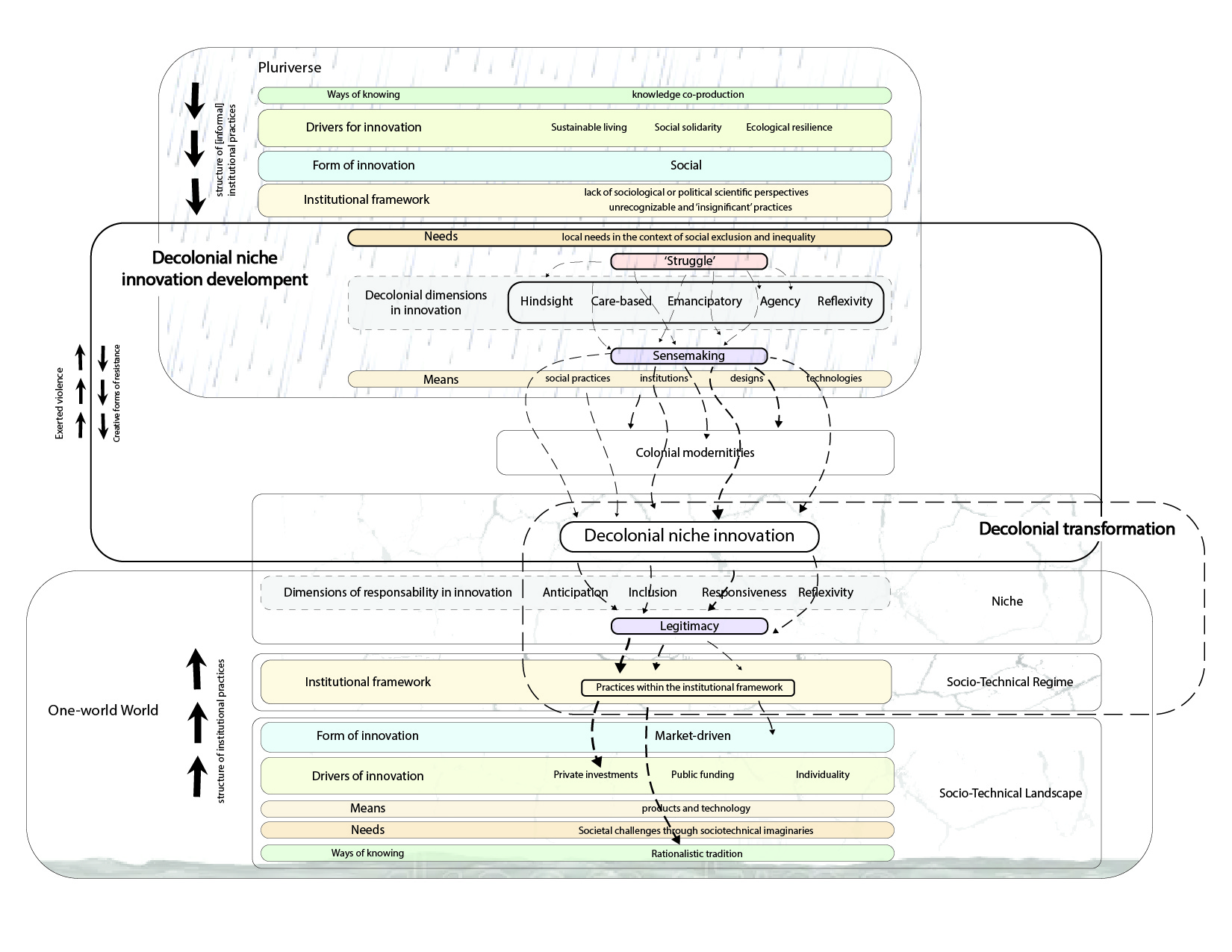
The present concept map portrays the two dominant poles –the One-World World and the Pluriverse– through which social, political and economical dynamics originate –and determine– correspondingly, niche innovations and Decolonial Niche Innovations (DNI).
The spatial arrangement of the concept map manifests a confluence of hierarchical and systematic flows where the Pluriverse is located on top as a form to defy the common interplay between submission and dominance where typically the rationalistic tradition is hierarchically superior, dominant and influential. On the contrary, the OWW underlies the entirety of societal structures leaving the Pluriverse as something that is yet still to be apprehended by systems: the Pluriverse remains far from the grounds of reality and within the realm of ideas, utopias, and dreams. The Multi-Level Perspective of Frank Geels (2002) is then positioned in order to contextualize power dynamics and to acknowledge the role of colonial history, within these somewhat opposing forces.
The process undergone by Decolonial Niche Innovations as seen in relation with the Multi-Level Perspective (MLP) of Geels (2002), is surrounded by more steps, barriers and intricacies that, only like raindrops, manage to fall from the realm of the ideas; leak through the cracks of the system, and populate the regime.
Taking on the model of MLP by Geels, arrows are used to show the permeability and magnitude of the genesis and impact of DNI within the overall system. Under the MLP perspective, the hegemony of the One-World World regime is contested and influenced on a systematic level incorporating DNI and then creating Decolonial Transformations.
[Full essay available upon request]
References